
Manual / Show Control
OSC Destinations
A destination is a named OSC connection – host, port, protocol, and, for TCP, framing – defined once and referenced by name from any number of OSC transmitters and trigger zones. Repointing a whole show at a different console or a changed network is then a single edit: change the destination's host and every transmitter and zone that references it follows immediately, with no restart.
Where it lives
Destinations are managed under Output → OSC Destinations, above the OSC Transmitters that use them. Click + New destination to add one. Each destination is a collapsible row with Save, Duplicate, and Delete; drag the handle on the row to reorder.
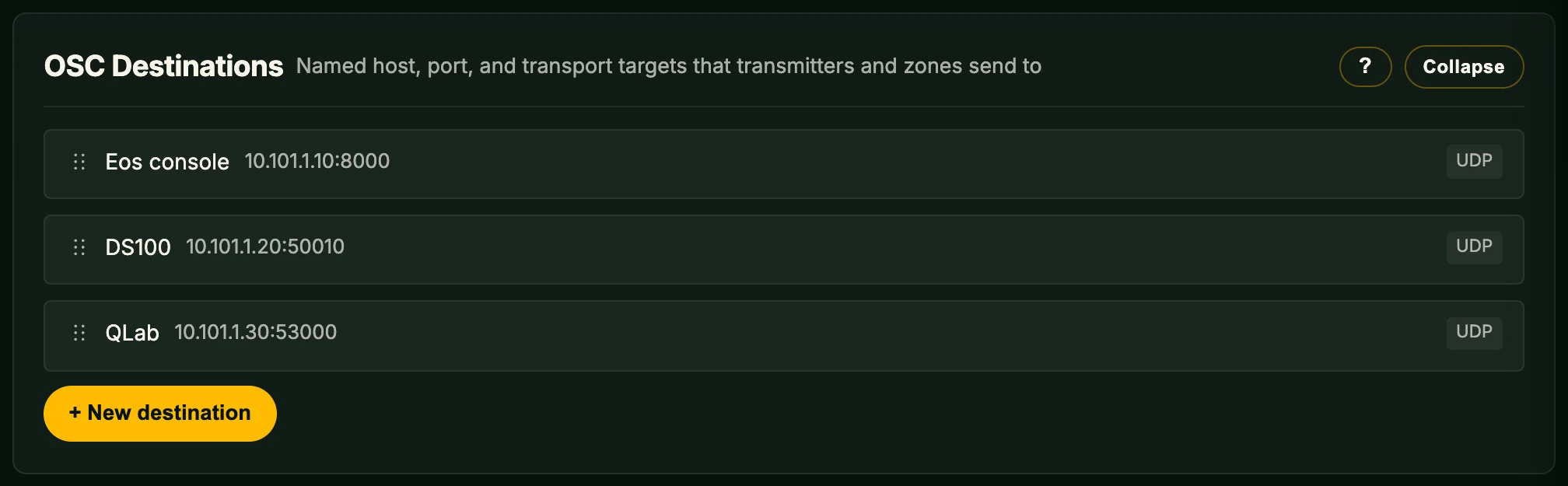
Anatomy of a destination
Each destination carries:
| Field | Meaning |
|---|---|
| Name | The label you pick it by on a transmitter or zone. |
| Host / Port | Destination IP address or hostname, and UDP/TCP port (1–65535). |
| Protocol | UDP or TCP. |
| Framing | TCP only: SLIP (RFC 1055, default per OSC 1.1) or Length-prefix (OSC 1.0). See TCP framing & reconnect. |
| Source Interface | Read-only, shown in Advanced network mode: the interface messages leave from, set under General → Network Interface Assignment. |
Referencing a destination
On each transmitter and trigger zone, pick a destination by name. A blank reference – or one pointing at a destination that has since been deleted – safely sends nothing rather than erroring. Deleting a destination stops every transmitter and zone still pointing at it until you repoint them. Destinations travel with config export / import, so a cloned station keeps the same named connections; they are not part of peer broadcast.
TCP framing & reconnect
For TCP destinations, OpenFollow supports two framings:
- SLIP (RFC 1055) – default per OSC 1.1.
END=0xC0; literal0xC0bytes escape to0xDB,0xDC; literal0xDBescapes to0xDB,0xDD. - Length-prefix – OSC 1.0. Each packet is preceded by a 32-bit big-endian length.
Pick the framing your receiver expects. The Framing field appears on a destination only when Protocol = TCP; UDP destinations have none.
TCP reconnects use capped exponential backoff: 0.25 s → 0.5 s → 1 s → 2 s → 5 s, holding at 5 s and resetting after a successful send. While a TCP destination is down, sends drop on the floor (matches UDP loss policy) – a transmitter's Diagnostics tab shows the connection state.
Hot-reload: editing config without restarting the service preserves any TCP connections whose destination didn't change. Destinations whose host / port / protocol / framing changed reconnect.
Related chapters
- OSC Transmitters – the per-transmitter senders that reference these destinations, with their triggers, message templates, and placeholders.
- Zone Occupancy Detection – trigger zones send their event messages to a destination too.
- Output Protocols – overview of the four output protocols (PSN / OTP / RTTrPM / OSC).